Why a client portal is the unfair advantage for service businesses
In a commoditised market, the thing that wins is rarely the work itself. It is whether the client can see what is happening. A client portal is the cheapest moat a service business can build, and most of your competitors will never bother.
Everyone looks the same on paper
Print brokers, agencies, trades, fit-outs: from the outside they all make the same promises. The client cannot tell who is actually better until the job is already running, which means you compete on price and referrals instead of on something defensible. That is a hard place to grow from.
What a portal actually changes
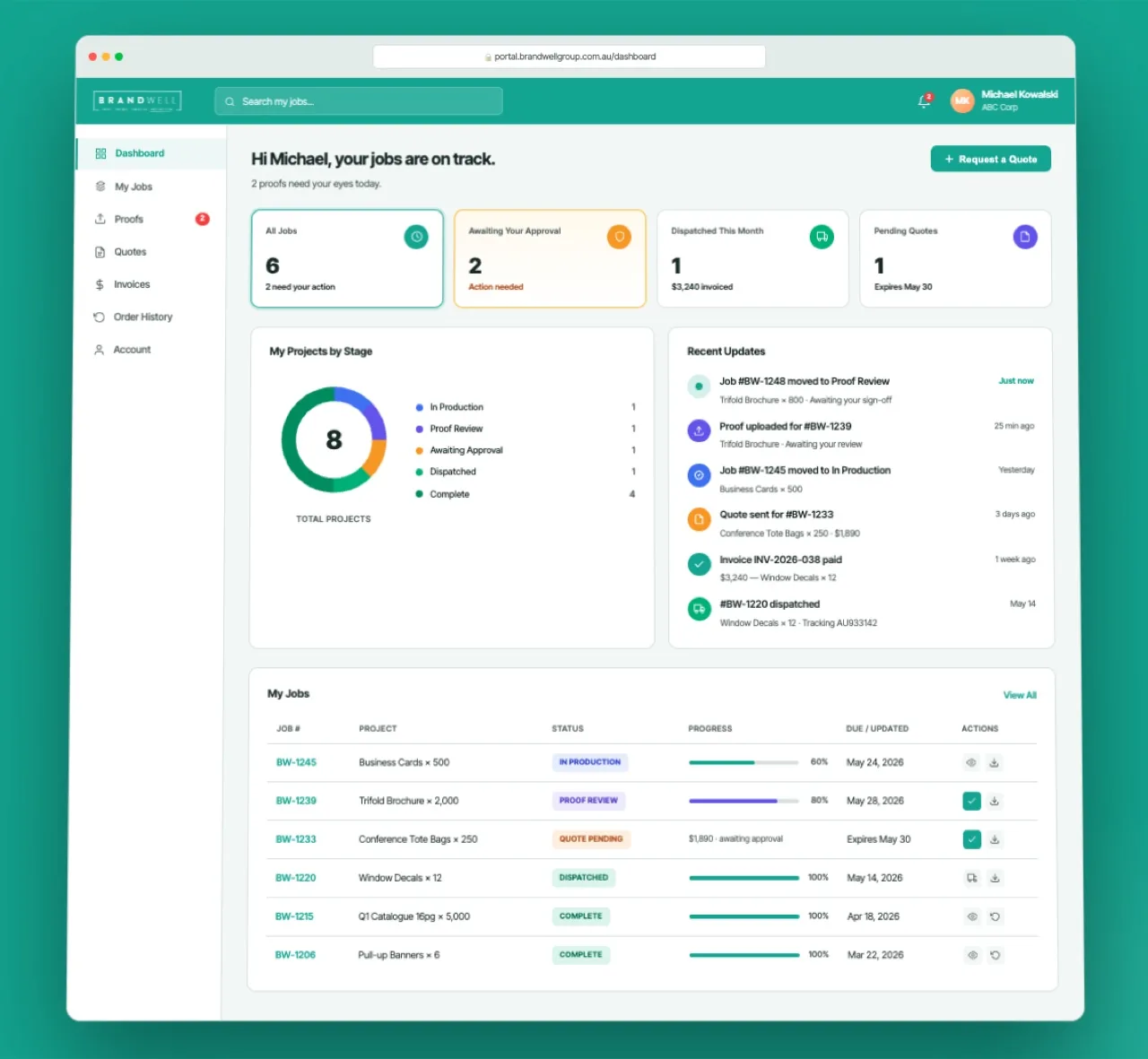
A client portal flips the relationship. Every client logs in and sees only their jobs: where each one is up to, the proofs waiting on them, the files, the invoices, and a full history that does not disappear when their account manager leaves. They stop emailing you for status updates because the answer is already in front of them.
We built exactly this for Brandwell Group, a print and production company that wanted to stop looking like a broker. The portal gives their clients an 8-stage view of every job from briefing to delivery, proof approvals, completed-job photos, and a one-click PDF of all jobs and spend that procurement teams pull straight into their budget meetings. You can read the full build in the Brandwell case study.
Why it is a moat, not a feature
Three reasons. It raises switching costs, because once a client's history and workflow live in your portal, leaving is painful. It signals scale, because enterprise buyers expect a real system, not a spreadsheet emailed around. And it compounds, because every job adds to a data trail that makes you more useful over time. Your competitors quoting on the same job have none of that.
Built fast, and built properly
The objection is always that this sounds like a six-month software project. It is not. We built Brandwell's portal alongside their website in a 10-day launch sprint. It runs on modern, production-grade tooling (Next.js and Supabase), with proper security: row-level data isolation so no client can ever see another's jobs, Google and Microsoft sign-in on a branded domain, and verify-then-sign file downloads. It passed an independent security review at A-grade before a single client logged in.
It is not only AI agents
We are known for the AI agents that run marketing, finance and operations, but the same team builds the rest of the stack: the website, the portal, the tracking, the automations. The question we start with is not "what can we build", it is "what is the moat this business needs". For Brandwell, it was a portal. For yours it might be something else. Either way, we build the thing that makes you hard to compare against.